Showing posts with label drama. Show all posts

Friday, June 15, 2012

Have a mind-bend, have a Picnic.

(Wassup, Angel-Faces? Long time no see!)


It says volumes about a piece of visual media that has for this long managed to confuse yet draw in countless generations of audiences, and I'm not talking about 'Lost' (ohhhh, HEADSHOT!).
Based on the story by the same name by authoress Joan Lindsay, Peter Weir's adaptation of 'Picnic At Hanging Rock'  is a vague yet eerily disquietning gem of Australian New Wave cinema. This film isn't about shock value or excess- it's exceedingly subtle, something that many people misinterpret as boring, but I assure you, when you watch the movie, in it's entirety, it is not an exercise in meaningless drivel. It's perhaps one of the most beautiful yet frightening things you may ever watch.

While everybody has a personal fear (mine is idiots with access to nuclear weapons, silly, right?), one of the few fears all of us as human beings share is the all-encompassing phenomenon of uncertainty. Uncertainty of each other, of the world. Not knowing what is to become of you is an eerie concept that all of us has thought about what stage or another. In the case of 'Picnic' the uncertainty comes from what happened to three school girls and their teacher who mysteriously disappeared during a beautiful summer day whilst on a high school outing. The film offers absolutely no conclusion as to what happened to any of them, there is only speculation and discomfort- it is all a disturbing conundrum that only suggests that what became of the missing girls and their teacher- absolute oblivion. For a second, let's just think about that word- 'oblivion'. What exactly does it refer to? Nothing, because oblivion is The Void, the ultimate riddle that nobody can explain or solve, dare I say, a fate that exceeds death and transcends life. I must confess, writing this now dear readers, I am unsure of what to precisely say about this movie without being too vague and for some reason, I feel a little light-headed.

                                                                     Effin' rock!

This movie only asks questions and reveals no answers, a fact that will divide us all, though one thing is for sure, no theory is too wild because of the way Weir translates the story. Upon further viewings, you may be tempted to follow some pretty obvious red herrings, but Weir is too intelligent of a film maker to spoon feed us anything, and you know what? It's brilliant. Weir doesn't underestimate the material he uses and he doesn't underestimate his audience, he treats us all as equals in this case because we are all in the same boat debating as to what happened to the girls and nothing he does choose to share with us is condescending.

Visually, the film looks and sounds sublime, like sleep walking in the hold of a fever dream with performances appropriate to the material to compliment it. None of the actors at the time were well known- in my opinion, it made their characters far more relatable and none the overwhelming. Imagine if they had re-made this movie today and cast some of the world's most bankable young stars. It just wouldn't have the same effect on the piece. Here we are watching people who could have been you or me.

                                                Not that Anne-Louise Lambert was offensive...

Naturally there will be folks out there who will argue and analyse tirelessly about other things we see in the movie- that it is a metaphor for sexual repression and anxiety (this movie does take place in the turn of the century), others may say that it is an allusion of feminism (such as the girls wandering out of the restrictive patriarchy that runs their school), others could be of the mind that it is a message about suicide, meanwhile others will just say "It's just a fucking movie!". The two three notions aren't right nor are they wrong, as for the third, if it's just a fucking movie, why are you reading this fucking blog? This movie was made for an audience with a brain in their heads with every desire to use it. Don't like it, fine, just don't ruin if for those of us who use our grey matter.

Sorry.

To me, this is not just one of the finest films Australia has ever produced, but one of the best mind-benders to grace the screen in history. It is the perfect mystery without a solution and asks no judgement, only opinions.It is not pretentious, and while by all tastes it is not utterly perfect, all it merely asks you what happened and divulges nothing as whether you were right or wrong. So, will you come on this picnic, or will you stay at home with your nice and safe TV dinner?

                                                                              See ya!

Sunday, January 29, 2012

A Story About Grief


First and foremost, if you consider yourself a 'true blue' horror fan, turn away now, because the marketing of this movie was hideously misleading. The international trailer promised thrills and chills, but I assure you, this film native to my country is nothing of the sort. This is a ghost story, but first and foremost, it is a story about the heartbreak of grief and the effects it has on us when it goes unresolved.
Shot in the format of a mockumentary/fakementary in the style of a news investigation, visually it's something we have all seen before, but in 'Lake Mungo's case, it is completely appropriate.

A close-knit family in rual Australia have just recently lost a beloved family member, Alice (Talia Zucker) in tragic and unseemly circumstances. They are looking for clues, answers, anything to give them peace of mind about Alice's untimely death. However, things aren't always as they seem, in fact, they are considerably more disturbing than they ever hoped to imagine, as various elements of her personal life come to light as the investigation progresses. Details about Alice's passing are dug up, as are details about her life, details that her family never even conceived of, and thus they come to grips with their own views of mortality.

                                           Imagine if this was somebody you love... or yourself.

In a way, director Joel Anderson owes somewhat to David Lynch's 'Twin Peaks' but rather make this film a mind-bender, it is more of a mind-infiltrator- little by little, 'Lake Mungo' travels under your skin by utilizing it's story and it's actors to maximum effect- grief is a universal sensation, and when it comes to losing somebody you love, be it a family member, friend or even a pet, you feel it. It can be encompassing, oppressive and it can make you feel utterly powerless, and it is these feelings that 'Lake Mungo' strives hard to achieve and for the most part, it is startlingly successful because it hits so close to the heart of all of us. The fact this movie is a ghost story is just part of the context- yes there are apparitions and disturbing moments that we can't explain, but the true horror comes from the reality of loss. There are no 'jump' moments, or heavy-breathing psychos or one-dimensional caricatures of humans, Anderson has chosen to conduct his film with a great sensitivity and the notion that less is more. He presents this film with great maturity and consideration not for money shots, but for the people.


As mentioned before the characters in the film aren't stereotypes- they are people, people who you could have known or may know. They don't spurt clever, hip dialogue, they don't cater to any particular gaze, the actors take their roles very seriously and not once does a performance feel forced or hackneyed. Of particular interest is Rosie Traynor as Alice's mother, June who is for the most part the anchor of the piece, given June has arguably taken Alice's death deeper than anybody else in her family, her story, her role and her point of view is that of ours. As she, her family and the news crew delve deeper into Alice's life, as do we.
Another character is not a human whatsoever, but it is the titular Lake Mungo itself, an actual place here in Australia that was thought to have been the first settlement of our human ancestors. Eerie yet beautiful, it has a distinct aura of deep wisdom as well as uncertainty. Legend has it that water is seen as a symbol of death as well as a means to travel through alternate realms, the Afterlife in particular.


On the downside, while several mysteries are resolved, other are not, namely a crucial incident in Alice's alternate lifestyle that comes as a shock. I won't reveal it for obvious reasons, but as we get closer to the penultimate aspect of Alice's fate, this other point is put on the back-burner that leaves you wondering why it was ever included in the first place if nothing else truly comes of it. It was rather disappointing because it truly gave insight to how troubled young Alice was in her final days. Another element that may be off-putting is that this is a slow-burner- it takes it's sweet time to reveal itself, and even then, not all questions will be answered. Those who like their mysteries to be obvious and their ghost stories thrilling and chilling, this isn't the ideal film for your tastes- 'Lake Mungo' is a mediation on humans dealing with tragedy, not demonic beasties from another realm.

The supernatural may at times be frightening, but in the endgame, what truly gets us the most are ourselves, especially when it comes to the loss of those we love. How do we react? What do we do? Do we do anything at all? And most importantly, how do we deal? Even if we know the truth may hurt us, we can't help but want to find a resolution, to find closure, because we want peace of mind, no matter what the cost may be. It is here that 'Lake Mungo' excels- this story isn't a blood-soaked scream, but whisper in your ear in the darkness of the beyond.

Trivia: The most chilling quote in the entire movie may sound bland without context, but when you see it in the movie, it not only makes sense, it will be sure to make your spine tingle: "I feel like something bad is going to happen to me... it hasn't reached me yet, but it's on it's way."


Trivia II: Unsurprisingly, the uncreative big cheeses in Hollywood want to remake this one. Good luck you lazy prats.

Tuesday, December 20, 2011

Death is cruel to the unsuspecting, immortality is unbearable to the knowing


While ostensibly a remake, Werner Herzog's 'Nosferatu The Vampyre' is actually an art form masquerading as a horror. True, there is a sense of true dread permeating in every frame, but it's not so much dread of a superficial movie sense, instead, it's a dread that strikes close to home for every viewer. We are not afraid of death itself, but of the anticipation of it, what the circumstances will be and how we will go out. Herzog explores this fundamental human fear by personifying it in the form of his greatest muse and dearest enemy, Klaus Kinski. When the film opens, we see upfront we are in for one Hell of a depressing yet morbidly beautiful ride, in this case, we are treated to a lingering shot of the Mummies of Guanajuato to the soundtrack of Popol Vuh, a musical motif that will come back to haunt you as the film goes on. It's a simplistic scene, but it never fails to send a slight shiver down your spine because you are looking at real dead people of all ages, frozen in time, looking eerily like porcelain dolls.

                                                        Literally the first thing you see

Although I for the most part find arthouse films utterly pretentious, there are also a few out there that defy convention and actually have a story to tell, 'Nosferatu' being one of them. I know how bias that sounds, but one only needs to watch this film in it's entirety, on their own, without anybody gabbing in their ear to get an appreciation for it. While it is mainly a piece of art visually, the actors aren't left in the dust, rather, they are part of the picture. It also helps that while Kinski's Count Dracula is an abomination to behold, Isabelle Adjani  has the presence of a woman in a Waterhouse painting- visually flawless, untouchable but vulnerable. It is these two characters that act as the primary contrast between the beautiful yet ultimately fragile mortal life (Adjani) and bitter immortality (Kinski). The motifs of life and death are heavy in this movie, but I personally found it was these two actors who brought this notion truly close to the heart. When Dracula sees how indisputably devoted to Jonathan Lucy is, Dracula wishes to take part in such love, but she refuses him, saying nothing on this Earth could make her leave Jonathan's side for him, not even death itself. Just as Murnau's original did, Herzog chooses to deviate from the story, using the same plot points, characters are much the same in terms of their relationships, I find that Herzog's version is thematically and dramatically stronger, all the while not pissing on Murnau's work. Rather than trying to top what Murnau did, or insult the film maker's work for that matter, Herzog is paying respect to it. Neither version is better than the other per se, just different, and it is this difference that makes Herzog's version shine.

                                                         "I hate it when you do that!"

Despite this film having a general grounding in human reality, Herzog wisely incorporates the deathly mysticism of death, through not only Dracula himself, but also his effect on the living. You see, Dracula is Death who can't die by his own hand, and thus, the only thing he can do is keep himself existing by feeding on the weak. In order to do this, he travels with armies of plague rats, wherever he goes, they go and disease and death result. Although Dracula is a powerful and encompassing being, he is also pathetic to the very core, and he knows it. He doesn't embrace what he is with feverent passion, he is all to aware that he is not meant to be on this Earth as there really is no place for him. While he may not be truly inevitable as death itself, he is indiscriminate like an illness that will only stop when he is exterminated. One could say that the rats are his preferred company because they too are seen commonly as vermin and undesirable by the living. In a spectacularly disturbing yet simultaneously beautiful sequence, Adjani's Lucy stumbles through her town square watching the townsfolk celebrate their inevitable death by reveling like they truly are going to die tomorrow. She sees formally set dinner tables laden with food with rats crawling over them, people are joining hands and chanting festive songs, one man even tries to mount a goat, all because they know this is the end. Herzog affirms that when people can no longer panic about the inevitability death, all they can do is embrace it.

Ahhh, but we do need a bit of levity. Perhaps one of the most fantastic and astounding portrayals of Renfield can be found here in the form of Roland Topor. I honestly haven't seen anything else by this guy, but damn is he ever the gleefully endearing maniac. You hate Topor's stupid giggle and idiotically optimistic face for about five minutes before you end up loving him. So devoted he is to Dracula, so much like a dog, unconditionally loving yet afraid, he even rubs himself against his master while whining like a puppy. He literally lives to serve this freak of nature It's unlike anything you have ever seen, seriously. Well, perhaps in high school.


To my mind, there have been many reviews before me who have written up this film who have done it more justice than I have, but if you still need some convincing, all I can say is that this film is a beautiful nightmare in motion that will likely draw you in like a fly in a web slowly succumbing to the spider's venom and there is nothing you can do to escape it, and in the end, you will welcome it.

Wednesday, November 30, 2011

Frankly my dear, I DO give a damn


Love it or hate it, 'Gone With The Wind' is and always will be a cinematic and literary phenomenon. Even in the 21st century, re-releases of both the film and the novel are constantly being churned out and people continue to lap it up. It is overrated, overpraised, and inflated, but above all, it is one of the most ambitious projects ever known to humanity for almost a century and will stay that way for perhaps another hundred years more. When you compare this against 'Twilight' and 'Harry Potter' I will bet dollars to dounuts that GWTW will remain standing. But I suppose time will tell.

GWTW well and truly set the benchmark for the term epic- sweeping story, rounded (though not always endearing) characters, trials, tribulations, love, both idealised and unrequited, complete with an almost mythical sense of romantacism and melodrama. But perhaps the key aspect of the film that people look over when admiring it's passion is that at it's core, it's about the most primal of human needs- to survive. Honestly, I could go on and on about the sumptuous production values, costumes, score and everything that helps make David O. Selznik's passion project sing, but let me focus on the characters, the ones who are in the thick of it all. All of these characters are polarized to the extent of almost fancy, and yet, you can admire all of them.

Vivien Leigh's Scarlett O'Hara is not a nice person. When we first meet her, she is self-centered, spoilt, vain and proud. She wants every man chasing after her, but the only man she wants (or, THINKS she wants) is Ashley Wilkes, or rather, the version that she sees, not the man himself. When the gracious Melanie (Olivia deHavilland) remains her friend for thick and thin, all Scarlett can do is curse her good name behind her back. Despite these flaws of character and good conscience, she is also incredibly tough. She is able to let loose a few buckets of tears before she picks herself up and continues, stronger than before. While her more shallow traits are off-putting, it is Leigh's determined nature that makes Scarlett not just a woman, but also a fierce force of nature that we all wish we could be in times of adversity.

                                                   Bitch, bitch, bitch, that's all you ever are.

Similarly, the character of Rhett Butler (Clark Gable), is quite the morally questionable rogue who takes a shine to Scarlett. He sees himself in her, and despite the fact deep down he wants to live an honorable life, he knows he is not that sort of man. All the same though, he appreciates genuine compassion when he sees it, although Scarlett isn't one to give that... well, selflessly. For all intents and purposes, Rhett is indeed a bastard. He's a loose character who is proud of the indiscretions he has committed and yet, like Scarlett, he has an indominatable character. He is a fearless blockade runner who uses his wits and charm to get out of sticky situations, and he has a mostly nonchalant attitude when he is cornered. At one point he is playing cards with some Yankee guards in a jail, with the possibility of execution hanging over his head and here he is laughing and being completely chummy with them. He even has the audacity to shut the door to his cell in the face of an officer when Scarlett comes to him.

                         Doesn't hurt his cause none because he has a FAB mustache.

Scarlett's opposite, the previously mentioned Melanie could have been boring and nauseously one-note were it not for deHavilland's performance. When you look at deHavilland, you can't help but think of her as an Angel of Mercy, ready to bestow forgiveness against all who wrong her. Even when Scarlett was caught kissing her husband, Ashley, Melanie stands by Scarlett, firecely defending her honor, right to her grave. Yes, Melanie is a total pascifist and disgustingly selfless, but deHavilland captivates you- you may call her a sap, but you really must admire her virtuous nature and her unfaltering loyalty to her family and friends. Rhett Butler especially is grateful for her, and it is she who he chooses to confide in during his moments of doubt and personal pain. In a way, Melanie is the ideal woman. When I say that, I mean the ideal woman of the time of which the novel was written, not as women SHOULD be in the present. You may not agree with Melanie's strong morals and unconditional love no matter how much it blows in her face, but you can admire her will to love as passionately as she possibly can and still retain her dignity.


The only character that I didn't really care for was Ashley Wilkes (Leslie Howard). Howard isn't a bad actor at all, and his embues Ashley with all the nobility and stoicness the novel possessed, but character wise, he was weak. Scarlett sees him as gallant and strong, but in reality, he, like Melanie is submissive, despite his loyalty. Also, when I look at him, I think "This guy over Rhett Butler? Seriously? Come on!". Once again, this is absolutely no fault of Howard's, he is playing the character to a T, but the character himself is almost boring. However, when paired with Melanie, if the term 'soulmates' had been coined back when GWTW was made, it no doubt would have applied to the pair of them.

When you look at the contrasting relationships between the two lead couples, you can see a distinct divide between them. Melanie and Ashely's relationship is based upon trust, dependence and domesticity, it is the idealised version of love that to this day, film continues to perpetuate. Meanwhile, the relationship between Scarlett and Rhett is unpredictable, passionate and wildness. Granted, their relationship goes downhill when they marry, but even so, Rhett is a man who knows what he wants and Scarlett is a woman who knows what she wants. They are a perfect match for each other because of their selfishness and desire to live. Although the relationship is quite fantastical and melodramatic, it also stands as a representation of love if it is not realised, something that is sadly quite common these days. Usually it takes a catastrophe to make people wake up to themselves, but in Scarlett and Rhett's case (in the movie at least), it is far too late for them.


                                                                                  VS.


I know how anti-climactic this write up has been for those of you hoping to get massive insight to the film in general, but I find that already, countless articles of literature have been composed dedicated to every facet of GWTD that to have an amatuer such as myself try to offer anything new would be old hat. However, honestly speaking, this is one of my favourite films for all of the reasons why it has been lauded. There is no such thing as an unequivocably perfect film, but if GWTW is as popular now as it was back in 1939, that is saying something. There is a timeless quality about this film that will no doubt continue to bewitch audiences to come.

Wednesday, July 13, 2011

Perfection Comes With A Price


What can I say about 'Black Swan' that for the most part has not already been said by people who have enjoyed Darren Aranofsky's (quite frankly more compelling) rendition of popular ballet 'Swan Lake'? Nothing. Seriously, I got nothing to add. Now, while I didn't think this was a brilliant film across the board, that it not to say that it hasn't earned the positive praise it has garnered, especially the tour-de-performance of Natalie Portman as troubled ballerina Nina Sayers who just wants to be the best she can be. This is one of those movies that you have seen time and again, but as I always say, it's all in the execution and this one takes off splendidly. Now what has THIS got to do with possession? Read on.

This movie has all the right ingredients to be an effective psychosexual thriller that deals with the losing and finding of identity, repression, fighting personal inhabitions and giving it to the great void. If we look at this movie from the angle of demonic possession, it may make you scratch your head, but look at it from this perspective- you have a fragile human soul in the form of Nina being victimized by her own insecurity, an insecurity that takes many forms, one of them being free-spirit Lily (Mila Kunis). Lily isn't the BEST ballet dancer like Nina, but she does her dancing with more emotion than Nina ever has, and this affects Nina profoundly. On top of that, Nina is haunted by her demanding stage mother who wants to live vicariously through her daughter, to feel the glory she misses now that she is 'old hat'. Nina is babied, coddled and shaped by her mum, even her room looks like that of a girl child's. Then there is the matter of her ballet instructor, Tomas (Vincent Cassell), a man who uses some pretty unorthodox methods to coax the best out of his dancers, one of them being sexuality, something Nina finds almost foreign.

                                                  I will keep my own thoughts here quiet :D

All of these things comes to a head when Tomas surprisingly gives her the role of the White and Black Swan in his upcoming re-imagining of 'Swan Lake'. Nina is brillaint as the White Swan, but she lacks the passion and lust for life the Black Swan possesses, a fact that frustrates her when she sees Lily who is the very embodiment of that. So encompassing is this desire of Nina's that she subjects herself to various methods of becoming like Lily, one of them being striking up an actual friendship with her (and you know where THAT leads.). In another case, after a... shall we say, STIMULATING rehearsal with Nina, Tomas encourages Nina to pleasure herself so she is not so frigid in her performance. She does this, but then is inhibited by an outside presence which only inflames her frustrations. All of these things are demons that are possessing Nina, following her, getting into her mindset, influencing her actions, pushing her towards the very edge with devastating results.

                                                  Creatively smashed mirrors being a bonus

Forgive me for giving in to the elephant in the room, but seriously, Natalie Portman for the most part IS the movie. Certainly not to take anything away from Kunis and Cassell, both of whom are in fine form, but this movie is all about Nina and her affliction, and Portman commits herself to her character. You have to remember that not only is Portman dancing, she is also acting through her dancing, and trying to emote what Nina is feeling must have been no small feat for Portman when she was preparing for this role. I'd say that the awards she has been given were DAMN well earned.

                                                     Well done. Now eat this burger, woman!

Hopefully now somehow I have convinced you that this is more than just what it has been sold to be, and more than just an excuse to show (admittedly steamy) sapphic sex. This film is for all intents a movie about possession, but this time, it's not Satan, Legion or Glenn Beck. It is about the demons of the mind and how they are perhaps the most potent demons of them all. In the case of 'Black Swan' while succumbing to your demons may lead you to glory, there is still a price to pay- would you be prepared to pay it?

Wednesday, June 22, 2011

Father's day


Often you will see films about in the wake of an apocalypse the collapse of society and the people who live in it. While these are natural developments, it's not often you see a film adapted from a book that reverses this aspect. In John Hillcoat's rendition of Cormac McCarthy's best-seller 'The Road' it is about the eternal bond between a father and son in a dead world. Both learn from each other, as a line in prose reads: "Each other's world entire..." and one cannot live without the other. You can guess just how hardy this dynamic is in a world where suicide is two bullets in a revolver away.


Although the cataclysm that has destroyed the Earth goes unnamed, that is not what this film is about- it is about family and the ties that bind. The rest of humanity has devolved into tribes of cannibalistic nomads, and the Man (Viggo Mortensen) takes it upon himself to raise the Boy (Kodi Smit-McPhee) to be a decent man so that he may 'carry the fire'. Although McCarthy' book is simplistically written (there is no grammar or chapter division), there is so much power in those words that translate effortlessly onto screen. While 'The Road' untowardly presents itself as a cautionary tale, it also reinforces the fact that deep love is indominatable, such as that between a parent and child.


As the two principal characters are really the only ones we see on screen for the most part, Mortensen and Smit-McPhee commit themselves to the piece. Although neither have a great many lines at a time, their connection can be seen through looks, body language and gesture. Mortensen's Man's only purpose is to protect the one he loves, and it is a job he fully intends to carry out, even if it means sparing his son from a fate worse than death by nearly shooting him several times. There are times that the Man's resolve to protect his son using extreme measures reach through the screen and grab onto your own state of mind- would you allow your flesh and blood to be raped and gradually eaten by strangers, or would you put an end to that misery by killing them yourself. They seem like extreme measures now, but if what happened in this film happened to you, could you go through with it? Mortensen and Smit-McPhee sell this relationship without ever devolving into schmultzy or ham-fisted territory.
But for every moment of moral distress we are shown, we also see the triumph of love. There is a sequence in which the Man gives his son a can of Coke. Given the son was born after the catastrophe, he has never seen or tasted such a basic luxury we take for granted now. It's so simple yet so poignant to see the look of delight on the Man's face when the son savours his drink.


 Addtionally, props must be given to Charlize Theron for not only does she understand her role, she also understands the nature of it that it never comes off as thankless. While the character of the Wife was only told in flashback and never makes an appearance in the story itself, I thought it was fantastic on Hillcoat and Theron's part to incorporate the Wife into the movie, because that way you are given a clearer picture of the Man's character. Theron's final scene with Mortensen is low-key but nevertheless absolutely amazing, and I am glad Hillcoat took the risk of showing us the only other connection the Man had in the aftermath of the apocalypse and the only other reason for his existence.


As depressing as 'The Road' can be, it also meditates on how important love and human will influences who we are and how we alter our environment. The world we have been given is as fragile as glass and we need to not only take care of each other, but it as well. All of what we have can be taken away in an instant, and it really is up to us to taking nothing for granted. These are generic words, but works like 'The Road' makes you believe that it is true- there is only so much of our fate we can control, so what will happen when something out of our control turns our world upside down? It's up to us to carry the fire.


So, how was YOUR day?


Jesus fucking Christ. I want to kill myself. That was a slight exaggeration, but trust me, my feelings in regards to this movie as below are not.

The threat of nuclear warfare has haunted each and every one of us since the atomic bomb was made and used in Hiroshima, and this threat only intensified during the Cuban Missile Crisis, when the world was literally watching the skies in fear. Countless films have been made about this aspect of our fears, and many of them have been met with a chill down the spine and a shudder (the dream sequence in 'T2' has been said to closely resemble what would actually happen in a nuclear attack- thanks James Cameron). But for every one of these dream sequences, 'The Day After's, and others of it's ilk, this well-made pill of arsenic makes you feel like your gut has exploded and makes you want to slit your wrists at the same time. 
As this film chronicles, society is a fragile tapestry made up of threads, and the moment they unravel, as does the entire thing.
The thing is, this is the type of movie people say "Well don't watch it", that makes you watch it anyway because the material compells you so strongly to do so. My advice is- watch it, but I wouldn't blame you if you never watch it again.


Mick Jackson is not a particularly prolific film maker, but that doesn't mean he has no skill, especially when it comes to presenting us with a more than bleak vision of the future should the world succumb to a nuclear apocalypse.
Although only set in the small British town of Sheffield, the effects of the attack will resonate within all who watch it wherever they may be. And here's the kicker- this was made in 1984. Now while this IS a movie and it has been called as such, what also makes it stand out is that it is filmed as if it were a documentary. The characters in this film are solid (though some performances are take it or leave it), but the major draw is showing how all of the social network goes to Hell in a hand basket in the event of an indiscriminate catastrophe. This isn't shaky footage- you see everything. You see decomposing, burned corpses, you see milk bottles burst apart when the nuke hits.


You see people with thousand-yard-stares wandering aimlessly about simply because they have no place to go. You see nameless faces succumbing to the devestating effects of radiation, malnourishment and diseases that run rampant. You see the feeble attempts made by the government to control this devastation with little to no effect. The situation is absolutely hopeless for everybody. Nobody wins, there are no heroes who save the day, there is no trimuph over adversity. There are no assurances that anybody could live because this is life, life that could potentially be real if the people of the world don't communicate with each other.
To make matters worse, all of this doesn't just take place over a matter of months, by the time 'Threads' ends, it is a full 15 years after the attack and civilization is the equivalent of the middle ages in terms of technology and labor with not one hope in sight. 15 years of nuclear winters, lack of resources, onsets of disease and nobody to help. To top THAT off, as if that wasn't enough already, human communication has since become a series of hardly recognizable goobledigook as there is no time for education. In once sequence we see a woman watching a video with no sound, mouthing the words of the presentend on screen but she does not know the meaning of them. What matters is merely staying alive, whatever measures must be taken. This makes 'The Day After' look like a preschooler's cartoon.

                                                                This is a GOOD day.

This is a must-see film, but it's not one I will ever want to see again because it gets the message very loud and alarmingly clear. There is no winning when it comes to warfare, espeically of the nuclear kind- the only thing you will gain is a scorched Earth with nothing else in it. Do you really want that?

Tuesday, June 21, 2011

Worlds Apart


                        YES, ANOTHER PERIOD PIECE! DON'T YOU LOVE ME!? :-D

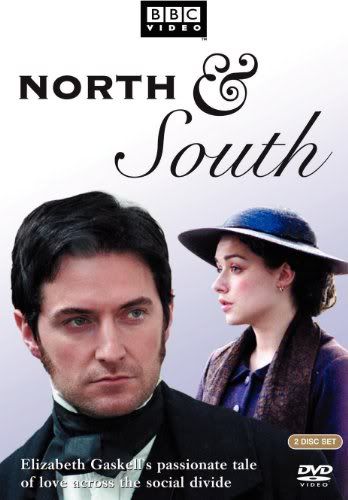
BBC's re-telling of Elizabeth Gaskell's novel is gorgeous as it is depressing. I haven't actually read any of Gaskell's work to compare how this adaptation translates, but I must say, if this isn't one of the most passionate stories of repressed emotion in times of hardship and distress, I don't know what is. Think of this film as 'Pride and Prejudice' only more realistic and much more depressing.


Enjoy it while you can, love.

Margaret Hale (a lovely Daniella Denby-Ashe) is a dreamer from the idyllic south region of England who values her freedom as well as her right to speak as well as her good manners. When her father decides to pick up sticks and head for the heavily industrial north, all of the colour and love is sapped from her world and replaced by smog, cotton mills and poverty. Things don't get any better when she meets the proprieter of the local mill, a dark, brtual man by the name of John Thornton (Richard Armitage in his break out role), as he's beating the crap out of a factory worker.


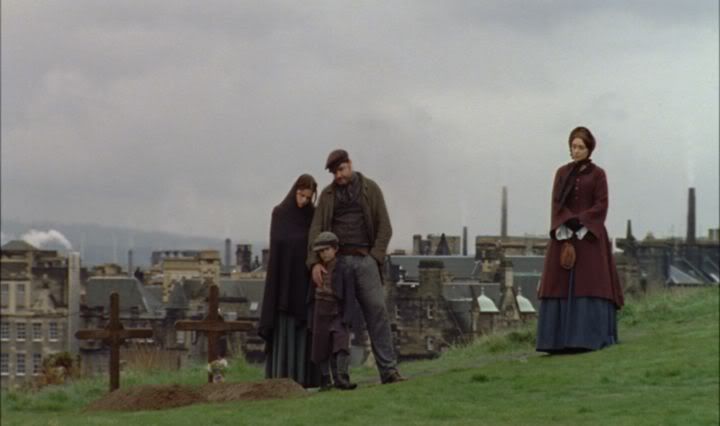
                                            It doesn't help the mill is next to THIS lovely place...

Margaret and her mother don't share Mr. Hale's enthusiasim for the culture of the north, and how could they? All it is is work, death and an absolute dirge of society where the only place fully open to the public is the cemetary. When Thornton strikes up a casual friendship with Mr. Hale, Margaret is forced into closer proximity with Thornton, a prospect that frightens yet intrigues her. At the same time, as she is gradually getting used to the north's oppressive atmosphere, she becomes friends with several of the mill workers, all of whom have a different opinion of Thornton... which of course gives Margaret second thoughts about the brute's character...


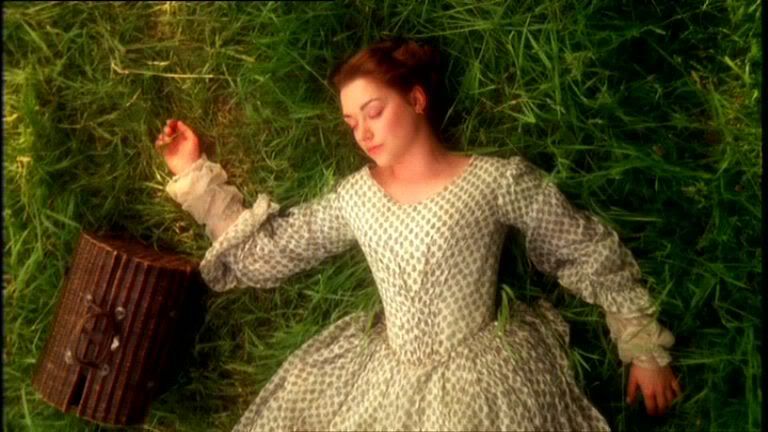
                                     You wouldn't know it, but they secretly wanna make babies

I think one of the many reasons why I loved this miniseries so much is that it doesn't travel the road most walked. I mean, this tale is set during the Industrial Era- people were working, but due to the poor conditions that many places had, they weren't working very well. This was also the beginning of forming unions, worker's rights and trying to form a better working environment, something that not all business owners wanted. What I also loved was that the two leads are not like Elizabeth Bennett or Fitzwilliam Darcy, they are more like real people in a real environment who feel real emotions, and it doesn't shy away from the fact that the consequences of every action they make has consequences. The only 'soft' sequences take place in Margaret's beloved south, but it is truly the north that draws you in. However, there is an almost epic love story here that will not make you roll your eyes. Although it is not in your face, there is a passion between them, that were it not for the fact they are worlds and manners apart to begin with, they would act on in an instant. This passion is repressed, but boy is it ever there. You want these two to end up together despite the fact each thinks the other is a fool when they first meet. And if you have seen this or read the book, you know it happens, but not without some serious screw ups along the way.


                                                            How could you blame him?

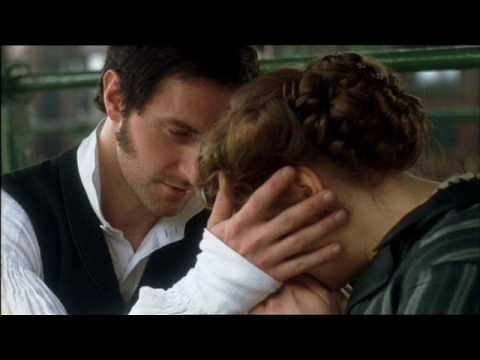
Naturally, we need human anchors in a production like this to make this love story work. Denby-Ashe and Armitage are more than up to the challenge. Margaret essentially is us, the audience, and we see what she sees, and what she sees influences what we think. When she first sees Thornton beating that hapless worker, like her, we think he is some coarse creature, and as Margaret gets to know him, even if at first it is not volunatrily, as do we. Every scene they are in, they command, if not share with each other and their co-actors, and you feel you are seeing these people, not actors wearing wonderful costumes. For every sequence of the depressing state of affairs in the north, we are treated to ones of tenderness and sensitivity that are almost impossible to resist.


                                                                           Like this.

For those romanatics who are looking for another period romance to add to their collection, this may not be for you if you are all about dancing, gentility and light humour. If you are expecting something like this in 'North and South', you would be sorely mistaken (not to mention very misguided if you think every Victorian story has that stuff). This is one for romantics who don't mind that stuff, but are more realistic in their expectations. These are romantics who know that with with great passion comes great consequence, and 'North and South' fits that bill in spades. It hurts, but it hurts so good.

Tuesday, April 19, 2011

Rake and Virtue

I am a very vanilla person once you get to know me. I'm soft as a powder puff and twice as gentle (thanks for the line Miss Kitty :D). If I have money to spare, I give it to charities, if I see person overloaded with bags I'll help them to their car, if you ever held a gun to a kitten's head I would beg you to spare it... before I'd give you a self-righteous knuckle-sandwich. At the end of the day, I'd rather be in a good relationship rather than a bad one, but there are films, shows and stories out there that don't show a good relationship between a man and a woman, and it is those things I have a massive interest in. Case in point...


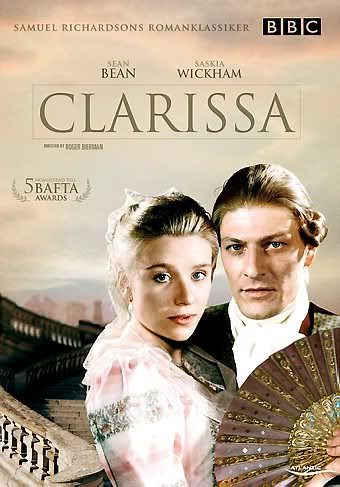
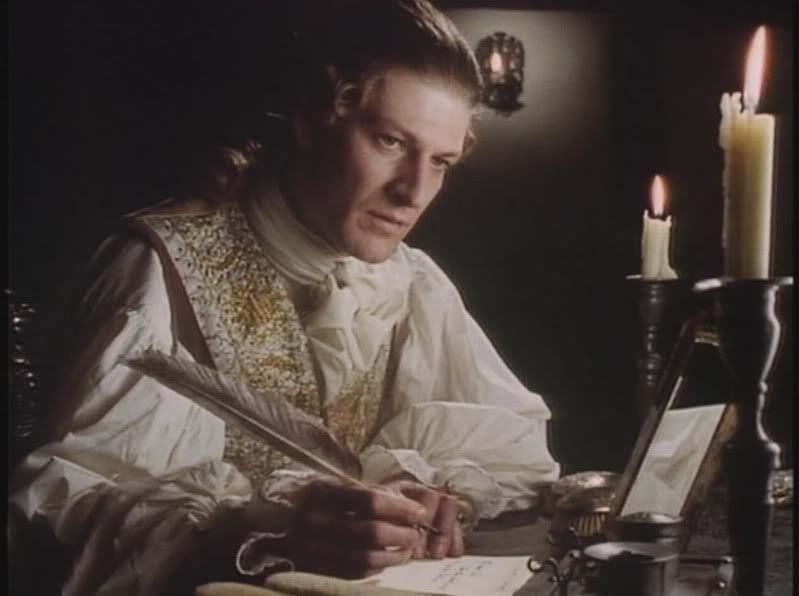
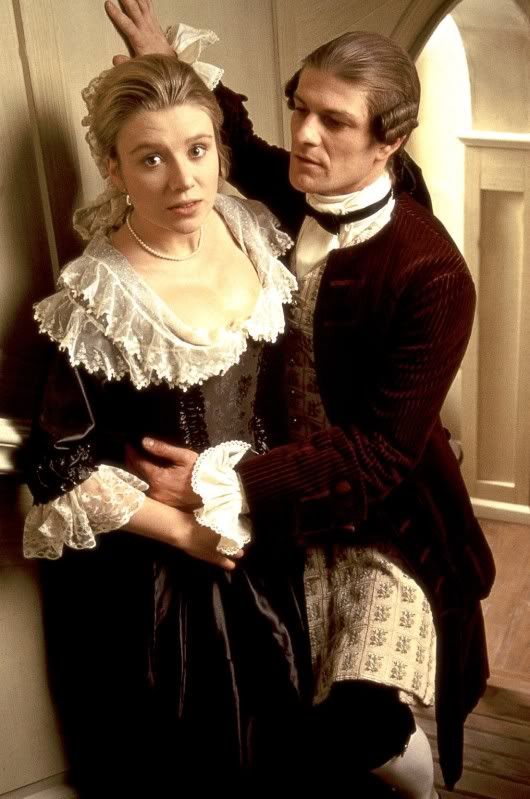
Based on the 17th century novel by Samuel Richardson, Richard Bierman's re-telling of this Georgian melodrama focuses not on the tender courting of it's lead characters, rather the fact they are virtually incompatible but they have a dangerous dynamic. The pure and virtuous Clarissa Harlowe (Saskia Wickham) is heir to a sizeable fortune due to her good and generous nature, something she does not want. She is content to live a modest life as long as she has her letters, books and independance. Despite this, her devious siblings feel that Clarissa should be put in her place and they coerce their father to entrap Clarissa in an engagement with an odious man she does not want and take away what few pleasures she has. Enter the debonair rake, Robert Lovelace (Sean Bean). A morally bankrupt man who is as notorious for his aberrant personality as he is for his conquests who sets Clarissa in his sights- he wishes to possess Clarissa, body, mind and soul. To achieve that, in his opinion, would be an act of God. And given Lovelace's opinion of himself, he is just the man for the job...

Dear Diary- I am a prick.

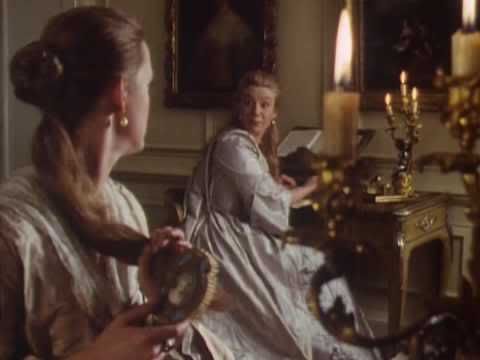
You'd be quite correct in assuming this lavish BBC adaptation is a melodrama because that is precisely what it is. Placing a naieve ingenue in a series of perils that threaten her being was a token staple of books of this period and it's done justice in this miniseries. Now, while this melodrama is being played right down the line, it really is the acting that gives this production it's boost. Were it not for Wickham's steely interpretation of the lovely Clarissa, the character would have been obnoxious and boring. For all of her piety and gentility, Wickham imbues Clarissa also with a wisdom that makes her a formidable combatant against Bean's Lovelace. While she may have the wool pulled over her eyes, Wickham's Clarissa is able to rely on her intelligence and wit to see her through each of Lovelace's advances.


In saying that, Bean's scheming villain Lovelace is a real piece of work. When he isn't being overt toward Clarissa, he is gleefully subversive. This is a man who enjoys the reputation he has because he knows he has the power, or at least feels he does. The more he spars with Clarissa, the more he begins to lose this control and he begins to develop feelings for her. Once again, this character may have been mustache-twirling quality on paper or in the hands of a lesser actor, but Bean gives Lovelace many layers to work with, at times he can be an absolute snake, others he can be a gentleman, but never sacrificing his agenda.


What a couple

While I have absolutely no gripes towards the rest of the capable cast, this really is Wickham and Bean's show. The relationship between their characters is dangerous as it is complicated, but not without some note of sexiness. Mind you, while Lovelace is still an ugly character, his desire for Clarissa to be his is pretty infectious, at least to me. Does he really want to simply ruin her or does he actually want to have a future with her? It's this sort of relationship that I personally love to watch, because while I value my ultimate desire to be safe, seeing something like this is a whole lot more interesting. Given I also have an interest in the Georgian period, when relationships between people appeared a lot more formal, underneath was a completely different story. In 'Clarissa' this vindicitive side of life is shown in well-recognized detail. Special props must be given to how the dialogue was scripted- given Richardson's prose was obviously not suited for television and actors, the writers must be given special credit for adapting this dialogue and making it a lot easier to follow. You can also feel the conviction of this work when the actors deliver their lines that you can actually understand what they saying and that it doesn't feel forced.
I don't truly have any issues with the series itself- given it's source material, I'm not going to accuse of being something that it makes itself out to be anyway. Perhaps it is also due to my bias toward content of this nature, but while I wouldn't say this is the best novel adaptation EVER, it would be a crime of fans of this genre and content to miss this. If you don't dig Austen, give Richardson's tale a go. For all of it's properness on the outside, there is delicious malice on the inside, and that, my friends, is what will win your heart.

Thursday, January 27, 2011

Rule 303

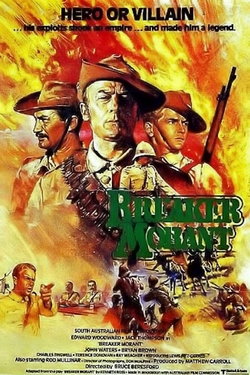
It's not often I see a film from my own country that I feel bursting pride for. You see, many of the Australian films I have watched have either been the tired 'Aussie battler' sub-genre (a likeable Aussie larakin dealing against umimaginable odds and earns a happy ending), or goofy, over-drawn comedies (the ABYSSMAL 'Welcome to Woop Woop'). If I had to make a short list of national films I have enjoyed, they would be 'Priscilla: Queen of the Desert', 'Picnic at Hanging Rock', 'Muriel's Wedding', 'Shine', 'The Castle', 'Red Hill', 'Mad Max' (I and II FTW), 'Lantana', 'Wolf Creek' and the subject of this review 'Breaker Morant'.


Very short history lesson- the Second Boer War was fought between 1899 and 1902 and within those years, the British Army enlisted Australian troops to fight within their military forces against the South Africans. One of the most famous war crimes that occured was the unwarranted execution of a South African prisoner and a subsequent execution streak of six more before a German missionary who supposedly witnessed the incident was sniped down. In an attempt to form an armistice to end the war, Lord Kitchner ordered a trial to bring Australian soldiers Harry Morant, Peter Handcock and George Witton to justice in order to show that the British empire does not tolerate barbarism amongst it's own soldiers. However, this impromptu trial was very much steeped in controversy because the accused soldier's defense attorney was given only a day to prepare- in other words, this case was quite shady. Stranger still, the accused were Australian and there was no mention of British soldiers committing any atrocities though one can be certain they did. On top of that, there was evidence to show that Morant, Handcock and Witton were liable for clemency, but these items were dismissed during the trial. Were Morant and his colleagues truly culpable of this crime, or were they being used as scapegoats?


Bruce Beresford may not be a director the world is familiar with, but his works are quite distinct- no matter how black and white the subjects of his films may initially sound, he changes those colours into shades of grey and avoids didactism. In this movie's case, he doesn't flinch from insinuating the possibility that the deeds Morant and his colleagues committed occured, but he doesn't accuse them either. Rather, he shows that in war, acts of violence may have justification, in Morant's case, it was out of self defense. While there are rules of war soldiers are supposed to follow, in moments of extremity, those rules do not apply- self preservation does, in this case, the only rule Morant and his men were following was Rule 303.


                                                            Alas, Fate is ultimate.

This movie does not plea for the audience to have undying sympathy for the accused men, nor does it point the finger, and it is this approach that truly makes this film brilliant (on top of the fantastic talent). This film is a rich example of a character study during a time of crisis and uncertainty. One of the most striking features of this movie is that it involves excerpts of Morant's poetry during his incarceration that acts as a Greek Chorus of sorts throughout the proceedings of the movie. While first person narration could be construed as being unreliable, we are indeed seeing this movie through Morant's eyes and thus, we are only aware of what Morant was aware of while the rest of the events in the movie have either been taken from court transcripts and hearsay. We may not have known Morant's life up until this point, but in the film's case, what matters is what is happening here and now. Whether or not we believe it is completely up to us. If anything, rather than Morant and company's motives being in question, it is the military order of which they served that is placed under scrutiny. The British military has always been known for it's efficiency, strength and adherance to rules of engagement, but that does not mean that it is always an honorable institution, just like any other enforcement organization.

If I were a dictator, I would make you all watch this film, but since I am not and I just don't have the money or inclination to become one (:-P), all I can do is strongly recommend it, but I can promise that after you see this gem, 'Crocodile Dundee' will not be the only movie that you think of when you see the term 'Australian film'. Please do yourself a favour and see it.

For the record, I have absolutely nothing against 'Crocodile Dundee'.

Saturday, January 8, 2011

Mommie Dearest


When people think of Stephen King, they automatically conjure up his best-selling horror novels, while some may think of the uplifting Shawshank Redemption or the subtly magical The Green Mile. Although quite a few of King's works have not made a positive transition from page to screen, the ones that work are the ones that people can relate to in one way or another, in this case, it is the gritty and underappreciated Dolores Claiborne.


                                                            Bates (as always) is amazing


Directed by Taylor Hackford and boasting talent such as Kathy Bates, Jennifer Jason Leigh and David Strathairn, this film doesn't deal with the supernatural whatsoever or even a slight of hand. No, this movie investigates the issue of domestic violence, a problem that has unfortunately been plaguing lives around the world for God knows how long. Additionally, it deals with the notion that while mothers can be loving and warm people, they can also be as fierce as beasts and the lengths they will go to when it comes to the protection of their children.


  The Devil is beside her


While this film is decidedly low key in many respects, when scenes of a man beating up on his wife come on screen, they hit you hard and they stay with you throughout the movie, add to that the grainy look of the film- very few clear skies, frosty air and a distinct sense of depression that saturates every scene- it seems as if the environment has only compounded the sense of desolation Dolores Claiborne feels every day.
Now some of you may be thinking that just because there are no scary creatures and excessive blood and guts in this movie, that doesn't make it scary- how wrong you are. You see, no matter how outrageous King's work may be when it comes to dealing with the metanatural, all of his books center around the characters rather than simply the circumstances. One could say that what truly makes King's works memorable are not the monsters in the closet, but the people whose house has the monsters in the closet. King invests a lot within his characters and in Dolores Claiborne's case, it shows.


It goes without saying that Kathy Bates as Dolores once again proves why she is an actress to be reckoned when it comes to playing such a layered character with many dark secrets who wants to be heard. Her Dolores may seem like a passive punching bag at first glance, but as you follow her story, you realise that she is mother grizzly bear (sorry for the Palinism) who has nothing to lose, and that, my friends, is more than a woman, but a force a nature.


                                                              The mother and her cub


While this film came out way back  in 1995, and while it shows flashbacks that dates back to the 60's the present timeline seems indeterminate, I feel that this factor works for the idea that no matter what the timeframe, humans almost never change and in a movie that investigates subject matter as hard hitting as familial abuse, it stays with you.


I also find that this film is quite faithful to King's prose which is another thing that works in the film's favour- when you deviate from a work that you are trying to translate to an audience, you are in danger of losing the essential parts of what makes the story true. Naturally not all the characters are PRECISELY as King wrote them, but the actors ensure that they make up for what their characters don't have by adding their of flavour to the roles, especially Judy Parfitt in her role as Dolores's employer.


While it is certainly not my place to dictate what type of movies you as the viewer should watch, do give this one an honorable try- it will not be to everybody's taste, but I feel that nobody will feel this film is absurd beyond comprehension because of the fact it is about humans and how frightening they can be as opposed to run of the mill serial killers wearing hockey masks hacking into screaming virgins (thanks Peter Vincent for that one :-P).


So, will you sit down and listen to Dolores's story?

Friday, January 7, 2011

War Is A Many Splintered Thing


China, circ 1860- a powerful and destructive rebellion sweeps throughout China resulting in not only the schism of the land but of the people, in particular, three blood brothers who are torn apart from political intrigue, shadow dealings and love.


Whoa. I love historical epics because of their grand, sweeping nature, how they reconstruct worlds past and their larger than life stories. While Peter Chan's The Warlords certainly possesses all of these, what truly caught me was that is was also a character study. Jet Li, Andy Lau and Takeshi Kaneshiro play blood brothers, who long ago swore they would remain together and let nothing tear them apart, only to have their bond shattered when war breaks out. I am no expert on Chinese history, and for all I know, the story behind this film could very well be an embellishment, but damn if the human beings in this story don't ring true to the veiwers in terms of their actions and emotions. I think what truly struck me was that the three lead characters were not strangers- they were closely connected, and therefore, the things that affect one, affect all of them, abeilt in different ways. When the rebellion severs their bond, they can do nothing to remedy it, instead the rift between them grows and the power of betrayal grows too strong. You can guess that things will not end in wine and roses by the time the blood dries on the battlefield.


Now, this is going to sound awful, but I really don't have a lot of favourite Chinese films save for the occasional horror that is served up only to be remade to suit English-speaking audiences. While I will certainly agree that Hero was a gorgeous example of myth, ultimately it didn't have a terrible lot of substance. Same can be said for House of Flying Daggers. Yes, they looked absolutely gorgeous and sublime, but they did not possess rounded out characters that the audience can relate to on a deeper level, and I find that this connection, the human connection is what should truly matter when it comes to historical epics of heroism, rebellion and relations between individuals. While Jet Li has done his fair share of action, the role he has in this movie is so much more rewarding than simply kicking arse and being the Token Chinese Badass in most American movies. Andy Lau, who I've had my eye on for a while proves that he is an actor who truly does deserve international recognition because he has one of the most expressive pair of eyes I have seen and here he uses them to maximum effect. Takeshi Kaneshiro is a bit of an enigma to me- a dear friend of mine loves him (and I will admit he is kinda cute), but I have not seen a lot of his past work to truly compare it to his work here, but he delivers a fine performance nonetheless. If I ever see him in any other movies, I will be sure to pay more attention to his work.


Don't go thinking this movie is all about beauty because it ain't- this is a VIOLENT film, people die in horrendous ways, there is rape and torture, there is humiliation and the ugliness of humans in war. All the same, the content is not put in for shock's sake- it is showing the reality of war and you don't need to be a rocket scientist to see that it is one of the worst things humans can inflict on each other (and yet we still do it). It's also the kind of movie that makes you wonder that if you were placed in the position of betraying somebody who is close to you in a circumstance such as war, how would you feel? What would you do? What would your reasons be if you did or what would happen to you if you did not? This is the type of movie that has characters that everybody can relate to, no matter where you come from or who you are. I probably wouldn't watch this movie over and over again because it was a heady journey the first time around, but I can assure you that this film is an experience that must be seen to be fully comprehended, better yet, watch the Director's Cut to get the maximum effect of this movie.

Wednesday, January 5, 2011

Clash of the Titans


Interesting little factoid for you; the lead actors Michael Sheen and Frank Langella played media showman David Frost and Tricky Dick respectively on stage together in the past. Moreover, Ron Howard said he would not have done the movie if he were not able to get the pair for his adaptation of Peter Morgan's play of post-Watergate Nixon Interviews conducted in '77 after Nixon abandoned the presidency and got a pardon from Ford.


Regretfully, I don't have oodles of money and I may never see the intensity these two men on stage replicated, but if I may be so bold, this film replaces what may have been more than adequately.


Who is the Spider and who is the Fly?


The movie is very much the cat-and-mouse, but is disguised by the world of politics and the media that hounds it at every turn. What started off as a run-of-the-mill interview of Nixon courtesy of Frost ended up to be the ultimate public eye trial of the disgraced former President resulting in a confession that most of America (and the world for that matter) wanted to hear. However, one truly fascinating feat this film (and Langella) achieves is giving Tricky Dick a face away from the public eye- the face of a desperate, ill yet proud man who tried to see justification in his acts only to see the traumatic results they caused. The way Frost, with the assistance of his producer and two little-known political hounds, who was regularly known to be a show pony of the airwaves transformed into Nixon's most worthy opponent in the media circuit surprised everybody, including Nixon himself.


Journalists or political assassins?


There truly is nothing I can say that hasn't already been said when it comes to praising Sheen and Langella's performances, and really, the rest of the principal cast should not be disregarded, however small their roles are compared to the leads. Special mention goes to Boomkat Favourite Kevin Bacon as Nixon's ex-secretary of defense and confidant Jack Brennan andToby Jones as political PR go-to Swifty Lazaar. If I may confess though, I was a little surprised to see Lucian from Underworld without his scruffy beard.


Is this even the same guy?!


Joking aside, while I'm not the person to speak with regarding politics, it's difficult to ignore the fact that the events of the film occured (give or take artistic license) and sometimes, you don't need explosions, gunfire, contrived plots and other embellishments to make an effective and suspenseful political thriller, regardless if it's source is a stage play and not a Robert Ludlum or John Grisham publication. It is a little heart-breaking too that Langella did not win Best Actor because his monologue over the phone to Sheen is one of the best I have recently heard.


Good show Mr. Howard, Sheen, Langella and co. You Are Not Crooks.


...


OT: I don't know about you, but I really do fancy Sheen, especially as Lucian: