Showing posts with label based on a novel. Show all posts

Friday, June 15, 2012

Have a mind-bend, have a Picnic.

(Wassup, Angel-Faces? Long time no see!)


It says volumes about a piece of visual media that has for this long managed to confuse yet draw in countless generations of audiences, and I'm not talking about 'Lost' (ohhhh, HEADSHOT!).
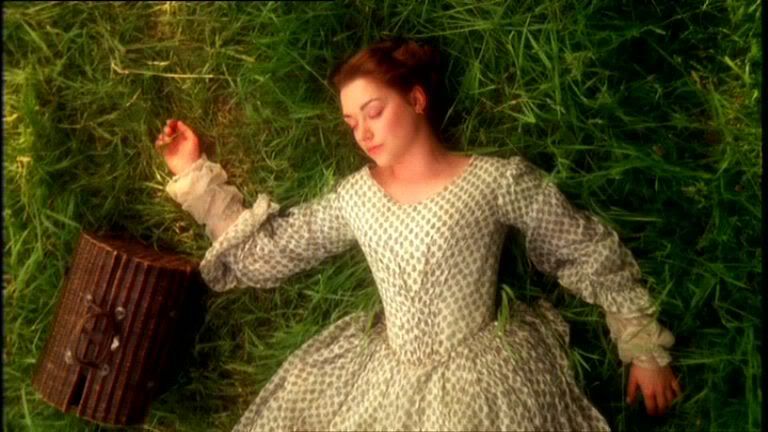
Based on the story by the same name by authoress Joan Lindsay, Peter Weir's adaptation of 'Picnic At Hanging Rock'  is a vague yet eerily disquietning gem of Australian New Wave cinema. This film isn't about shock value or excess- it's exceedingly subtle, something that many people misinterpret as boring, but I assure you, when you watch the movie, in it's entirety, it is not an exercise in meaningless drivel. It's perhaps one of the most beautiful yet frightening things you may ever watch.

While everybody has a personal fear (mine is idiots with access to nuclear weapons, silly, right?), one of the few fears all of us as human beings share is the all-encompassing phenomenon of uncertainty. Uncertainty of each other, of the world. Not knowing what is to become of you is an eerie concept that all of us has thought about what stage or another. In the case of 'Picnic' the uncertainty comes from what happened to three school girls and their teacher who mysteriously disappeared during a beautiful summer day whilst on a high school outing. The film offers absolutely no conclusion as to what happened to any of them, there is only speculation and discomfort- it is all a disturbing conundrum that only suggests that what became of the missing girls and their teacher- absolute oblivion. For a second, let's just think about that word- 'oblivion'. What exactly does it refer to? Nothing, because oblivion is The Void, the ultimate riddle that nobody can explain or solve, dare I say, a fate that exceeds death and transcends life. I must confess, writing this now dear readers, I am unsure of what to precisely say about this movie without being too vague and for some reason, I feel a little light-headed.

                                                                     Effin' rock!

This movie only asks questions and reveals no answers, a fact that will divide us all, though one thing is for sure, no theory is too wild because of the way Weir translates the story. Upon further viewings, you may be tempted to follow some pretty obvious red herrings, but Weir is too intelligent of a film maker to spoon feed us anything, and you know what? It's brilliant. Weir doesn't underestimate the material he uses and he doesn't underestimate his audience, he treats us all as equals in this case because we are all in the same boat debating as to what happened to the girls and nothing he does choose to share with us is condescending.

Visually, the film looks and sounds sublime, like sleep walking in the hold of a fever dream with performances appropriate to the material to compliment it. None of the actors at the time were well known- in my opinion, it made their characters far more relatable and none the overwhelming. Imagine if they had re-made this movie today and cast some of the world's most bankable young stars. It just wouldn't have the same effect on the piece. Here we are watching people who could have been you or me.

                                                Not that Anne-Louise Lambert was offensive...

Naturally there will be folks out there who will argue and analyse tirelessly about other things we see in the movie- that it is a metaphor for sexual repression and anxiety (this movie does take place in the turn of the century), others may say that it is an allusion of feminism (such as the girls wandering out of the restrictive patriarchy that runs their school), others could be of the mind that it is a message about suicide, meanwhile others will just say "It's just a fucking movie!". The two three notions aren't right nor are they wrong, as for the third, if it's just a fucking movie, why are you reading this fucking blog? This movie was made for an audience with a brain in their heads with every desire to use it. Don't like it, fine, just don't ruin if for those of us who use our grey matter.

Sorry.

To me, this is not just one of the finest films Australia has ever produced, but one of the best mind-benders to grace the screen in history. It is the perfect mystery without a solution and asks no judgement, only opinions.It is not pretentious, and while by all tastes it is not utterly perfect, all it merely asks you what happened and divulges nothing as whether you were right or wrong. So, will you come on this picnic, or will you stay at home with your nice and safe TV dinner?

                                                                              See ya!

Wednesday, November 30, 2011

Frankly my dear, I DO give a damn


Love it or hate it, 'Gone With The Wind' is and always will be a cinematic and literary phenomenon. Even in the 21st century, re-releases of both the film and the novel are constantly being churned out and people continue to lap it up. It is overrated, overpraised, and inflated, but above all, it is one of the most ambitious projects ever known to humanity for almost a century and will stay that way for perhaps another hundred years more. When you compare this against 'Twilight' and 'Harry Potter' I will bet dollars to dounuts that GWTW will remain standing. But I suppose time will tell.

GWTW well and truly set the benchmark for the term epic- sweeping story, rounded (though not always endearing) characters, trials, tribulations, love, both idealised and unrequited, complete with an almost mythical sense of romantacism and melodrama. But perhaps the key aspect of the film that people look over when admiring it's passion is that at it's core, it's about the most primal of human needs- to survive. Honestly, I could go on and on about the sumptuous production values, costumes, score and everything that helps make David O. Selznik's passion project sing, but let me focus on the characters, the ones who are in the thick of it all. All of these characters are polarized to the extent of almost fancy, and yet, you can admire all of them.

Vivien Leigh's Scarlett O'Hara is not a nice person. When we first meet her, she is self-centered, spoilt, vain and proud. She wants every man chasing after her, but the only man she wants (or, THINKS she wants) is Ashley Wilkes, or rather, the version that she sees, not the man himself. When the gracious Melanie (Olivia deHavilland) remains her friend for thick and thin, all Scarlett can do is curse her good name behind her back. Despite these flaws of character and good conscience, she is also incredibly tough. She is able to let loose a few buckets of tears before she picks herself up and continues, stronger than before. While her more shallow traits are off-putting, it is Leigh's determined nature that makes Scarlett not just a woman, but also a fierce force of nature that we all wish we could be in times of adversity.

                                                   Bitch, bitch, bitch, that's all you ever are.

Similarly, the character of Rhett Butler (Clark Gable), is quite the morally questionable rogue who takes a shine to Scarlett. He sees himself in her, and despite the fact deep down he wants to live an honorable life, he knows he is not that sort of man. All the same though, he appreciates genuine compassion when he sees it, although Scarlett isn't one to give that... well, selflessly. For all intents and purposes, Rhett is indeed a bastard. He's a loose character who is proud of the indiscretions he has committed and yet, like Scarlett, he has an indominatable character. He is a fearless blockade runner who uses his wits and charm to get out of sticky situations, and he has a mostly nonchalant attitude when he is cornered. At one point he is playing cards with some Yankee guards in a jail, with the possibility of execution hanging over his head and here he is laughing and being completely chummy with them. He even has the audacity to shut the door to his cell in the face of an officer when Scarlett comes to him.

                         Doesn't hurt his cause none because he has a FAB mustache.

Scarlett's opposite, the previously mentioned Melanie could have been boring and nauseously one-note were it not for deHavilland's performance. When you look at deHavilland, you can't help but think of her as an Angel of Mercy, ready to bestow forgiveness against all who wrong her. Even when Scarlett was caught kissing her husband, Ashley, Melanie stands by Scarlett, firecely defending her honor, right to her grave. Yes, Melanie is a total pascifist and disgustingly selfless, but deHavilland captivates you- you may call her a sap, but you really must admire her virtuous nature and her unfaltering loyalty to her family and friends. Rhett Butler especially is grateful for her, and it is she who he chooses to confide in during his moments of doubt and personal pain. In a way, Melanie is the ideal woman. When I say that, I mean the ideal woman of the time of which the novel was written, not as women SHOULD be in the present. You may not agree with Melanie's strong morals and unconditional love no matter how much it blows in her face, but you can admire her will to love as passionately as she possibly can and still retain her dignity.


The only character that I didn't really care for was Ashley Wilkes (Leslie Howard). Howard isn't a bad actor at all, and his embues Ashley with all the nobility and stoicness the novel possessed, but character wise, he was weak. Scarlett sees him as gallant and strong, but in reality, he, like Melanie is submissive, despite his loyalty. Also, when I look at him, I think "This guy over Rhett Butler? Seriously? Come on!". Once again, this is absolutely no fault of Howard's, he is playing the character to a T, but the character himself is almost boring. However, when paired with Melanie, if the term 'soulmates' had been coined back when GWTW was made, it no doubt would have applied to the pair of them.


When you look at the contrasting relationships between the two lead couples, you can see a distinct divide between them. Melanie and Ashely's relationship is based upon trust, dependence and domesticity, it is the idealised version of love that to this day, film continues to perpetuate. Meanwhile, the relationship between Scarlett and Rhett is unpredictable, passionate and wildness. Granted, their relationship goes downhill when they marry, but even so, Rhett is a man who knows what he wants and Scarlett is a woman who knows what she wants. They are a perfect match for each other because of their selfishness and desire to live. Although the relationship is quite fantastical and melodramatic, it also stands as a representation of love if it is not realised, something that is sadly quite common these days. Usually it takes a catastrophe to make people wake up to themselves, but in Scarlett and Rhett's case (in the movie at least), it is far too late for them.


                                                                                  VS.


I know how anti-climactic this write up has been for those of you hoping to get massive insight to the film in general, but I find that already, countless articles of literature have been composed dedicated to every facet of GWTD that to have an amatuer such as myself try to offer anything new would be old hat. However, honestly speaking, this is one of my favourite films for all of the reasons why it has been lauded. There is no such thing as an unequivocably perfect film, but if GWTW is as popular now as it was back in 1939, that is saying something. There is a timeless quality about this film that will no doubt continue to bewitch audiences to come.

Monday, November 28, 2011

The things we do for love...


The 80's was perhaps the best time to be a Freddy/Jason/Michael. No matter how paper thin your plot was, people came to see blood and cheese and expected nothing but mindless entertainment from you and your hapless, screaming horny teens. However, an unexpected dark horse arrived on the scene: 'Hellraiser'. Nobody quite knows where he came from or what exactly he stood for, but shit, he goes around tearing people up with hooks dressed in S&M leather with sharp pins lodged in his face, he HAS to be part of the grain!

Well no, actually. While the subsequent sequels of the franchise were most certainly a wonderful excuse to show off some creative red stuff, the first film is quite a different beast. For one thing, it was directed by the very man who wrote the novel 'The Hellbound Heart' which the film was based on: Clive Barker. Secondly, although Pinhead is perhaps the most iconic figure of the series, he is only in the film for at least 15 minutes, and even then, the movie wasn't about him. This movie was, and still is, a drama first and foremost. A ROMANTIC drama.


English fish out of water Julia has just married the loving and kindly American Larry Cotton and has moved into a new house to start a new life, however, Julia is still in love with Frank, Larry's sexual deviant brother, who passed away under mysterious circumstances. Julia is trying to settle in to married life and is attempting to  bond with Larry's daughter Kirsty when she makes a harrowing discovery- Frank is alive... yet not altogether whole.

                                                                      Frank: This is him. 


Julia, upon getting over her shock, is overjoyed when he tells her that they can be together again if she promises to keep his existence a secret, and if she brings unsuspecting schmucks back for him to kill and absorb their bodies to help repair his own. This is all going dandy (well, as it can be) until Frank tells Julia to sacrifice her husband, his brother. After this final sacrifice, Frank will become whole again and they will be together forever more. However, therein lies a dilemma- the mysterious entity Pinhead and his Cenobites will come a huntin' for him because of his cheating death, because the way they see it, Frank is robbing them their eternal due.

                                     Pictured left to right: Nemesis, Pinhead and Dan Ackroyd


There is no hiding the fact that this film boasts some truly off-the-wall, nightmarish shit with amazing visual effects. Bodies are blamelessly torn apart and Hell dimensions are opened, but believe it or not, it is the lead human characters who truly run this show. Clive Barker is no stranger to dealing with transgressions that plague humanity in his writings, and in this case, none of his notions are lost, a major rarity when it comes to horror films based off novels. Naturally, it all depends on how you view this film, but more often than not, 'Hellraiser' proves that horror, and it's characters for that matter, can be intelligent and relatable. The character of Pinhead himself isn't a wise-cracking asswipe, nor is he a silent momma's boy who wears a mask hacking up shrieking, big-breasted blondes. He is verbose, complicated and completely rational, you could almost argue he is perhaps the most sanest mind in the entire movie. Rather than coming across as an inefficient, single-minded killing machine, on the film poster, he's described as "... Demon to some, Angel to others" it's this kind of ambiguity that separates him from the typical boogeyman. In this movie, he actually comes off as a neutral force who just wants his payment, not bloody revenge. I would be remiss however if I didn't also mention the other actors, because they truly do carry the film. Andrew Robinson (yes, Scorpio from 'Dirty Harry')  brings a likeable, affable presence to the film, Ashley Laurence, Kristy, really is a wonderful surprise. Her character comes off as completely natural and not once does she resort to bimbo behavior, I LOVED her. However, major credit must be given to Claire Higgins, Julia. The woman is absolutely formidable to watch. Her proper demeanor has a distinctly classical sense of sinister beneath it that is hard to ignore. She was hateful, but at the same time, you could still understand her reasoning for her more extreme actions.

While there is no denying you could put a time-stamp on this movie by merely looking at it (hellooooooo shoulderpads!), and while it is not an utter masterpiece in every sense of the word and it may even come off to some as utterly pretentious, 'Hellraiser' is a seminal part of horror cinema that is more inclined towards telling a story with a view to real characters rather than how much blood can be spilled and how wide their bodies can be torn apart.

                                                                   Cheer up, bro.

Tuesday, July 12, 2011

BAD GIRL!


Confession- I saw 'The Exorcist' when I was 23 years young. After I had seen so many other horror films, I had become desensitised to cinema and genre. Consequently, upon first viewing Friedkin's acclaimed adaptation of William Peter Blatty's novel, while I certainly did feel it was worth a watch (as opposed to the supposedly "OMGAWESOME" 'Friday the 13th' which I felt was an over-bloated, badly-realised piece of sh--) I just didn't see WHY WHY WHY 'The Exorcist' had been bestowed with the reputation as one of the most important horror films ever. Obviously, back when it was made it frightened many of the bums in seats, but these days, unless you have the constitution of cheap toilet papter or if you are a religion nut, it's not that mind-blowing or spiritually confrontational upfront.

                                                                         WHUT?
However.

That doesn't mean I cannot appreciate the goods that this movie offers, and belive me, there are many of them, and all of this is apart from the fantastic actors who took part in this.

Upon recently watching it again recently (two nights ago), I found that this film's disturbing factor was more effective when it was subtle as opposed to in-your-face. Okay, sure, those possession scenes were crowd pleasers, but what appealed to me the most was this is a film that without the demonic possession, was still quite eerie. An example? The scene that made me the most squeamish was when little Regan was being tested in the hospital. You can masturbate with a crucifix, walk backwards downstairs and turn your head 360 degrees as much as you like, but those are nothing compared to seeing a child being subjected to all of these invasive medical procedures only to yeild no result. To me, due to it's realism, that entire sequence made me the most uncomfortable. Addtionally, seeing Ellen Burnstyn's Chris McNeal having to watch her daughter being poked and prodded gives it all that much more of an impact. And this is before the really nasty stuff happens.

                                                              That wasn't an invitation...

Other beautiful piece of subtlety can be seen when Jesuit wonderguy Father Merrin (Max von Sydow) merely faces off with an imposing statue of Pazuzu at an archaeological site. Nothing happens, but you can feel a tension rise within that moment when good and evil face off in the calm before a battle. I don't know what it was about it that worked so much for me, the camera work, the scenery, the incredible score, or even von Sydow's and the statue's presence in the same frame, but wow.

Okay, I'm done being introverted, let's talk about the money.

For a film that was made back in the early 70's before extreme censorship became a pain in everybody's butt, this one is a corker. Frankly, I don't believe I have seen many fantastic films that effectively shows a child being exploited in such a way. Visual effects or no, Linda Blair really did make the movie work, despite her young age. I wonder what her parents thought when she was cast in such a role and became immortalized in this portrayal. In saying that, equal praise must be given to Mercedes McCambridge. Who is she? Why, she was the voice of the possessed Regan/Pazuzu- every spurt of profanity, demonic gibberish and cackling was her, and even now, she doesn't recieve the praise she deserves.

                                                                 The voice of Pazuzu

In addition to the projective pea-green vomit, self-inflicted icon mutilation and head twisting, another thoroughly effective effect in this movie is almost always blink-and-you-miss-it: Pazuzu's face. I actually had to step through a few sequences in order to find these faces because they really are that fast. Now, some of you may laugh, but this face is pretty unforgettable:

                                                                              Gack.

Although it looks nothing like Pazuzu, when you are able to catch these subliminal flashes, they make you think "What was that?" as opposed to many films these days that rely simply on shock value and cat jump scares.

Now, when the movie comes to it's finale, it would be easy to dismiss that this film preaches the tired "God ALWAYS triumphs over Satan!" rhetoric- wait a moment. Pazuzu is a demon, yes, but he was not a demon of Christianity- he was Assyrian. That being said, while little Regan is exorcised of Pazuzu, he is not vanquished, he merely chooses another body of a priest who commits suicide- you think suicide is enough to kill a demon, a demon that is not of your faith? Bless you. Given this is explored in the sequels, I won't go further on this point, but despite the fact that faith won, it was for now, not forever, which is something Friedkin (and Blatty for that matter) emphasize- it never ends.

                                                                     Look! Paz Penis!

Wednesday, June 22, 2011

Father's day


Often you will see films about in the wake of an apocalypse the collapse of society and the people who live in it. While these are natural developments, it's not often you see a film adapted from a book that reverses this aspect. In John Hillcoat's rendition of Cormac McCarthy's best-seller 'The Road' it is about the eternal bond between a father and son in a dead world. Both learn from each other, as a line in prose reads: "Each other's world entire..." and one cannot live without the other. You can guess just how hardy this dynamic is in a world where suicide is two bullets in a revolver away.


Although the cataclysm that has destroyed the Earth goes unnamed, that is not what this film is about- it is about family and the ties that bind. The rest of humanity has devolved into tribes of cannibalistic nomads, and the Man (Viggo Mortensen) takes it upon himself to raise the Boy (Kodi Smit-McPhee) to be a decent man so that he may 'carry the fire'. Although McCarthy' book is simplistically written (there is no grammar or chapter division), there is so much power in those words that translate effortlessly onto screen. While 'The Road' untowardly presents itself as a cautionary tale, it also reinforces the fact that deep love is indominatable, such as that between a parent and child.


As the two principal characters are really the only ones we see on screen for the most part, Mortensen and Smit-McPhee commit themselves to the piece. Although neither have a great many lines at a time, their connection can be seen through looks, body language and gesture. Mortensen's Man's only purpose is to protect the one he loves, and it is a job he fully intends to carry out, even if it means sparing his son from a fate worse than death by nearly shooting him several times. There are times that the Man's resolve to protect his son using extreme measures reach through the screen and grab onto your own state of mind- would you allow your flesh and blood to be raped and gradually eaten by strangers, or would you put an end to that misery by killing them yourself. They seem like extreme measures now, but if what happened in this film happened to you, could you go through with it? Mortensen and Smit-McPhee sell this relationship without ever devolving into schmultzy or ham-fisted territory.
But for every moment of moral distress we are shown, we also see the triumph of love. There is a sequence in which the Man gives his son a can of Coke. Given the son was born after the catastrophe, he has never seen or tasted such a basic luxury we take for granted now. It's so simple yet so poignant to see the look of delight on the Man's face when the son savours his drink.


 Addtionally, props must be given to Charlize Theron for not only does she understand her role, she also understands the nature of it that it never comes off as thankless. While the character of the Wife was only told in flashback and never makes an appearance in the story itself, I thought it was fantastic on Hillcoat and Theron's part to incorporate the Wife into the movie, because that way you are given a clearer picture of the Man's character. Theron's final scene with Mortensen is low-key but nevertheless absolutely amazing, and I am glad Hillcoat took the risk of showing us the only other connection the Man had in the aftermath of the apocalypse and the only other reason for his existence.


As depressing as 'The Road' can be, it also meditates on how important love and human will influences who we are and how we alter our environment. The world we have been given is as fragile as glass and we need to not only take care of each other, but it as well. All of what we have can be taken away in an instant, and it really is up to us to taking nothing for granted. These are generic words, but works like 'The Road' makes you believe that it is true- there is only so much of our fate we can control, so what will happen when something out of our control turns our world upside down? It's up to us to carry the fire.


Tuesday, June 21, 2011

Worlds Apart


                        YES, ANOTHER PERIOD PIECE! DON'T YOU LOVE ME!? :-D

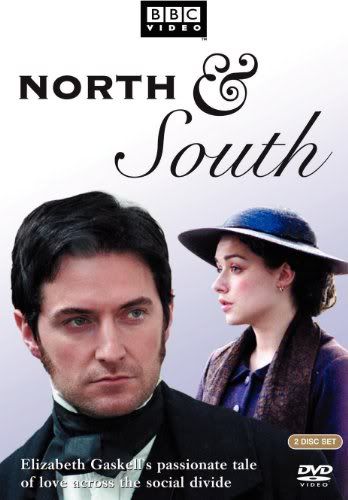
BBC's re-telling of Elizabeth Gaskell's novel is gorgeous as it is depressing. I haven't actually read any of Gaskell's work to compare how this adaptation translates, but I must say, if this isn't one of the most passionate stories of repressed emotion in times of hardship and distress, I don't know what is. Think of this film as 'Pride and Prejudice' only more realistic and much more depressing.


Enjoy it while you can, love.

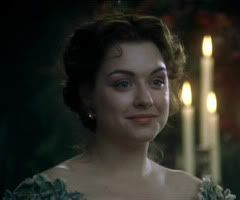
Margaret Hale (a lovely Daniella Denby-Ashe) is a dreamer from the idyllic south region of England who values her freedom as well as her right to speak as well as her good manners. When her father decides to pick up sticks and head for the heavily industrial north, all of the colour and love is sapped from her world and replaced by smog, cotton mills and poverty. Things don't get any better when she meets the proprieter of the local mill, a dark, brtual man by the name of John Thornton (Richard Armitage in his break out role), as he's beating the crap out of a factory worker.


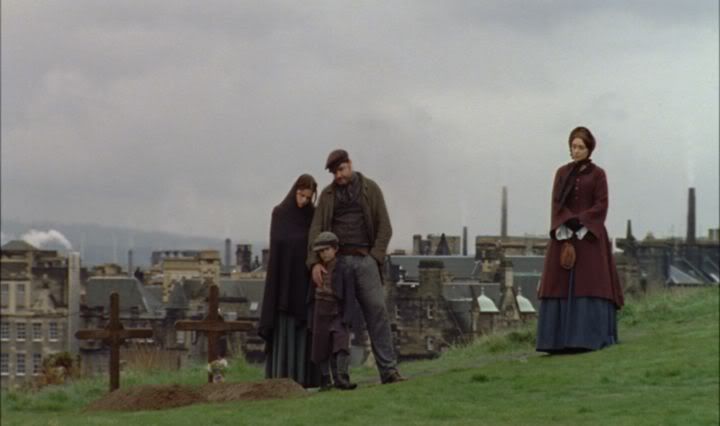
                                            It doesn't help the mill is next to THIS lovely place...

Margaret and her mother don't share Mr. Hale's enthusiasim for the culture of the north, and how could they? All it is is work, death and an absolute dirge of society where the only place fully open to the public is the cemetary. When Thornton strikes up a casual friendship with Mr. Hale, Margaret is forced into closer proximity with Thornton, a prospect that frightens yet intrigues her. At the same time, as she is gradually getting used to the north's oppressive atmosphere, she becomes friends with several of the mill workers, all of whom have a different opinion of Thornton... which of course gives Margaret second thoughts about the brute's character...


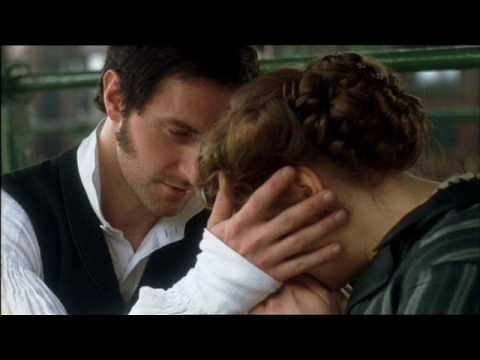
                                     You wouldn't know it, but they secretly wanna make babies

I think one of the many reasons why I loved this miniseries so much is that it doesn't travel the road most walked. I mean, this tale is set during the Industrial Era- people were working, but due to the poor conditions that many places had, they weren't working very well. This was also the beginning of forming unions, worker's rights and trying to form a better working environment, something that not all business owners wanted. What I also loved was that the two leads are not like Elizabeth Bennett or Fitzwilliam Darcy, they are more like real people in a real environment who feel real emotions, and it doesn't shy away from the fact that the consequences of every action they make has consequences. The only 'soft' sequences take place in Margaret's beloved south, but it is truly the north that draws you in. However, there is an almost epic love story here that will not make you roll your eyes. Although it is not in your face, there is a passion between them, that were it not for the fact they are worlds and manners apart to begin with, they would act on in an instant. This passion is repressed, but boy is it ever there. You want these two to end up together despite the fact each thinks the other is a fool when they first meet. And if you have seen this or read the book, you know it happens, but not without some serious screw ups along the way.


                                                            How could you blame him?

Naturally, we need human anchors in a production like this to make this love story work. Denby-Ashe and Armitage are more than up to the challenge. Margaret essentially is us, the audience, and we see what she sees, and what she sees influences what we think. When she first sees Thornton beating that hapless worker, like her, we think he is some coarse creature, and as Margaret gets to know him, even if at first it is not volunatrily, as do we. Every scene they are in, they command, if not share with each other and their co-actors, and you feel you are seeing these people, not actors wearing wonderful costumes. For every sequence of the depressing state of affairs in the north, we are treated to ones of tenderness and sensitivity that are almost impossible to resist.


                                                                           Like this.

For those romanatics who are looking for another period romance to add to their collection, this may not be for you if you are all about dancing, gentility and light humour. If you are expecting something like this in 'North and South', you would be sorely mistaken (not to mention very misguided if you think every Victorian story has that stuff). This is one for romantics who don't mind that stuff, but are more realistic in their expectations. These are romantics who know that with with great passion comes great consequence, and 'North and South' fits that bill in spades. It hurts, but it hurts so good.

Tuesday, April 19, 2011

Rake and Virtue

I am a very vanilla person once you get to know me. I'm soft as a powder puff and twice as gentle (thanks for the line Miss Kitty :D). If I have money to spare, I give it to charities, if I see person overloaded with bags I'll help them to their car, if you ever held a gun to a kitten's head I would beg you to spare it... before I'd give you a self-righteous knuckle-sandwich. At the end of the day, I'd rather be in a good relationship rather than a bad one, but there are films, shows and stories out there that don't show a good relationship between a man and a woman, and it is those things I have a massive interest in. Case in point...


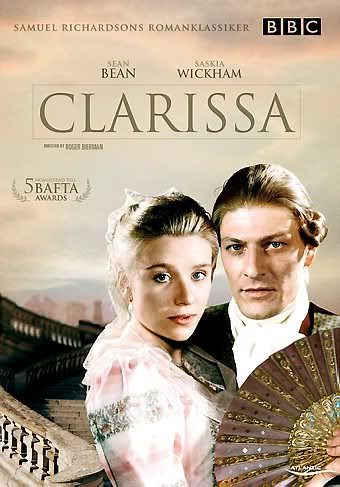
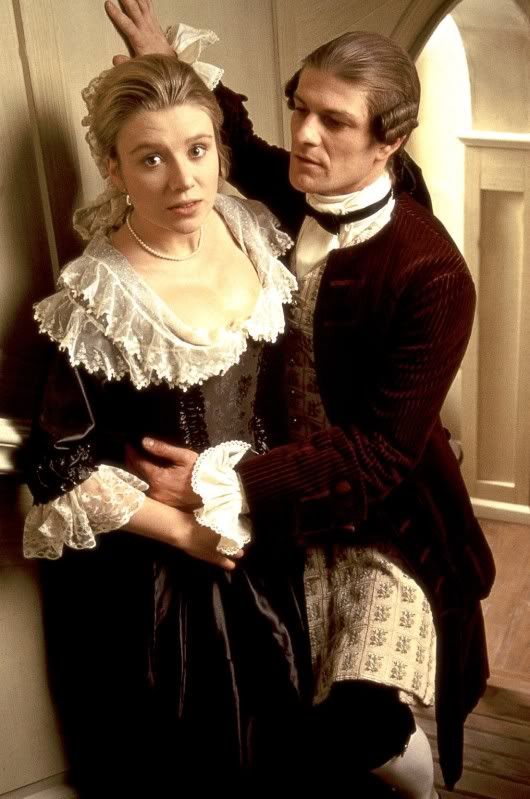
Based on the 17th century novel by Samuel Richardson, Richard Bierman's re-telling of this Georgian melodrama focuses not on the tender courting of it's lead characters, rather the fact they are virtually incompatible but they have a dangerous dynamic. The pure and virtuous Clarissa Harlowe (Saskia Wickham) is heir to a sizeable fortune due to her good and generous nature, something she does not want. She is content to live a modest life as long as she has her letters, books and independance. Despite this, her devious siblings feel that Clarissa should be put in her place and they coerce their father to entrap Clarissa in an engagement with an odious man she does not want and take away what few pleasures she has. Enter the debonair rake, Robert Lovelace (Sean Bean). A morally bankrupt man who is as notorious for his aberrant personality as he is for his conquests who sets Clarissa in his sights- he wishes to possess Clarissa, body, mind and soul. To achieve that, in his opinion, would be an act of God. And given Lovelace's opinion of himself, he is just the man for the job...

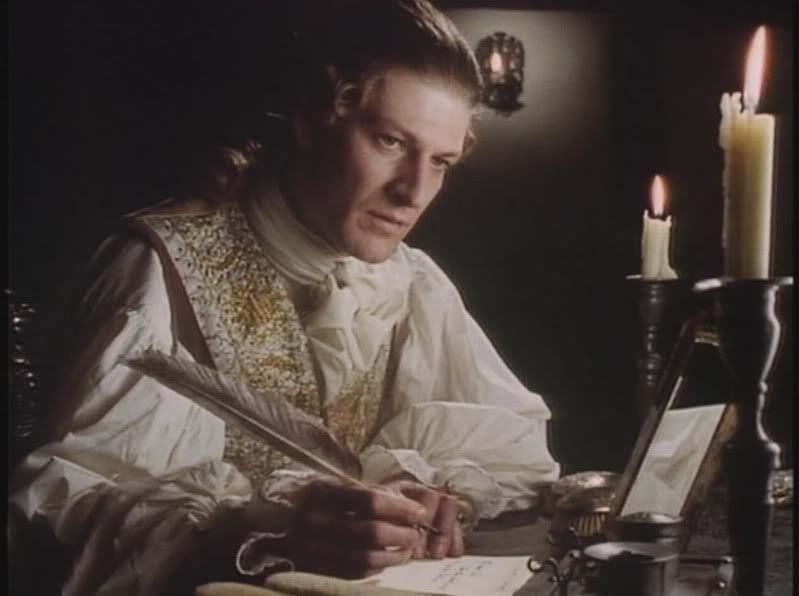
Dear Diary- I am a prick.

You'd be quite correct in assuming this lavish BBC adaptation is a melodrama because that is precisely what it is. Placing a naieve ingenue in a series of perils that threaten her being was a token staple of books of this period and it's done justice in this miniseries. Now, while this melodrama is being played right down the line, it really is the acting that gives this production it's boost. Were it not for Wickham's steely interpretation of the lovely Clarissa, the character would have been obnoxious and boring. For all of her piety and gentility, Wickham imbues Clarissa also with a wisdom that makes her a formidable combatant against Bean's Lovelace. While she may have the wool pulled over her eyes, Wickham's Clarissa is able to rely on her intelligence and wit to see her through each of Lovelace's advances.


In saying that, Bean's scheming villain Lovelace is a real piece of work. When he isn't being overt toward Clarissa, he is gleefully subversive. This is a man who enjoys the reputation he has because he knows he has the power, or at least feels he does. The more he spars with Clarissa, the more he begins to lose this control and he begins to develop feelings for her. Once again, this character may have been mustache-twirling quality on paper or in the hands of a lesser actor, but Bean gives Lovelace many layers to work with, at times he can be an absolute snake, others he can be a gentleman, but never sacrificing his agenda.


What a couple

While I have absolutely no gripes towards the rest of the capable cast, this really is Wickham and Bean's show. The relationship between their characters is dangerous as it is complicated, but not without some note of sexiness. Mind you, while Lovelace is still an ugly character, his desire for Clarissa to be his is pretty infectious, at least to me. Does he really want to simply ruin her or does he actually want to have a future with her? It's this sort of relationship that I personally love to watch, because while I value my ultimate desire to be safe, seeing something like this is a whole lot more interesting. Given I also have an interest in the Georgian period, when relationships between people appeared a lot more formal, underneath was a completely different story. In 'Clarissa' this vindicitive side of life is shown in well-recognized detail. Special props must be given to how the dialogue was scripted- given Richardson's prose was obviously not suited for television and actors, the writers must be given special credit for adapting this dialogue and making it a lot easier to follow. You can also feel the conviction of this work when the actors deliver their lines that you can actually understand what they saying and that it doesn't feel forced.
I don't truly have any issues with the series itself- given it's source material, I'm not going to accuse of being something that it makes itself out to be anyway. Perhaps it is also due to my bias toward content of this nature, but while I wouldn't say this is the best novel adaptation EVER, it would be a crime of fans of this genre and content to miss this. If you don't dig Austen, give Richardson's tale a go. For all of it's properness on the outside, there is delicious malice on the inside, and that, my friends, is what will win your heart.

Saturday, January 8, 2011

Mommie Dearest


When people think of Stephen King, they automatically conjure up his best-selling horror novels, while some may think of the uplifting Shawshank Redemption or the subtly magical The Green Mile. Although quite a few of King's works have not made a positive transition from page to screen, the ones that work are the ones that people can relate to in one way or another, in this case, it is the gritty and underappreciated Dolores Claiborne.


                                                            Bates (as always) is amazing


Directed by Taylor Hackford and boasting talent such as Kathy Bates, Jennifer Jason Leigh and David Strathairn, this film doesn't deal with the supernatural whatsoever or even a slight of hand. No, this movie investigates the issue of domestic violence, a problem that has unfortunately been plaguing lives around the world for God knows how long. Additionally, it deals with the notion that while mothers can be loving and warm people, they can also be as fierce as beasts and the lengths they will go to when it comes to the protection of their children.


  The Devil is beside her


While this film is decidedly low key in many respects, when scenes of a man beating up on his wife come on screen, they hit you hard and they stay with you throughout the movie, add to that the grainy look of the film- very few clear skies, frosty air and a distinct sense of depression that saturates every scene- it seems as if the environment has only compounded the sense of desolation Dolores Claiborne feels every day.
Now some of you may be thinking that just because there are no scary creatures and excessive blood and guts in this movie, that doesn't make it scary- how wrong you are. You see, no matter how outrageous King's work may be when it comes to dealing with the metanatural, all of his books center around the characters rather than simply the circumstances. One could say that what truly makes King's works memorable are not the monsters in the closet, but the people whose house has the monsters in the closet. King invests a lot within his characters and in Dolores Claiborne's case, it shows.


It goes without saying that Kathy Bates as Dolores once again proves why she is an actress to be reckoned when it comes to playing such a layered character with many dark secrets who wants to be heard. Her Dolores may seem like a passive punching bag at first glance, but as you follow her story, you realise that she is mother grizzly bear (sorry for the Palinism) who has nothing to lose, and that, my friends, is more than a woman, but a force a nature.


                                                              The mother and her cub


While this film came out way back  in 1995, and while it shows flashbacks that dates back to the 60's the present timeline seems indeterminate, I feel that this factor works for the idea that no matter what the timeframe, humans almost never change and in a movie that investigates subject matter as hard hitting as familial abuse, it stays with you.


I also find that this film is quite faithful to King's prose which is another thing that works in the film's favour- when you deviate from a work that you are trying to translate to an audience, you are in danger of losing the essential parts of what makes the story true. Naturally not all the characters are PRECISELY as King wrote them, but the actors ensure that they make up for what their characters don't have by adding their of flavour to the roles, especially Judy Parfitt in her role as Dolores's employer.


While it is certainly not my place to dictate what type of movies you as the viewer should watch, do give this one an honorable try- it will not be to everybody's taste, but I feel that nobody will feel this film is absurd beyond comprehension because of the fact it is about humans and how frightening they can be as opposed to run of the mill serial killers wearing hockey masks hacking into screaming virgins (thanks Peter Vincent for that one :-P).


So, will you sit down and listen to Dolores's story?

Wednesday, January 5, 2011

Psychosexuality Ahoy!


While this film is not prominent with serial killers, mistaken identities and elaborate murder plots, it feels almost like a soul sister to Hitch's psychological ripper Vertigo. The usually radiant Tippi Hedren takes a very prim and proper turn as Marnie, a frigid wallflower of a woman who aspires to achieve higher things, but something within her mind is keeping her back. Many obstacles block her way, one of them being wealthy widower Mark Rutland, (a smoldering Sean Connery, two years after making heads turn and womens' jaws drop as James Bond). While it would be a crime on my behalf to give the particulars away, what results is a study of repressed sexuality, paranoia and confusion, Hedren's character being the catalyst and the central victim of all.


What is the truth and what is the lie?


While this film possesses its own self-imposed flaws, due to budget, time and film constraints for the era, this offering by Hitch is respectable, primarily due to Hedren's performance as Marnie. Here the usually glamourous actress was given the perfect opportunity to dive deep into a complicated role and she came out a champion. If anybody who remembers her admittedly awkward performance in The Birds, they need not be wary here. Save for one somewhat ungainly moment, Hedren nails the role to the wall. Sean Connery meanwhile further cemented his reputation as a compelling actor as well as resident sex bomb, whose character makes it his mission to protect, analyze and even dominate the mystery that is Marnie. Given the Hayes Code that applied to cinema back in the day, much is implied rather than shown, but I feel it works in the favour of the tale. As expected, Hitchcock makes ample use angles, colours, a fitting score by the maestro Bernard Herrmann, and well-adapted screenplay based off the story by Winston Graham.


Can she be saved from herself... and him?


One of the things that struck me most was how sexual this film was. Granted, innuendo is no stranger to Hitchcocks' works, but this one managed to be a little more overt, and the sexual tension between Hedren and Connery's characters is so thick you could cut through it with a hot butter knife and still not reach the bottom of the cake. One particular sequence was rather racy for the time, involves one apex of the relationship between Marnie and Mark that takes place on a luxury liner that toes the line between passion and an act of imposed power. It all makes for a highly fascinating, though questionable relationship between the pair and it will no doubt leave the viewer questioning the integrity of Marnie and Mark's feelings.

While it is not as famed or impersonated as Psycho, or as talked about as Hitchcock's other blockbusters, Marnie rightly belongs in the pantheon of intelligent psychosexual drama/thrillers that have become increasingly rare in this uncompromising era of over-exposure and absurd censorship, mainly due to Hedren and Connery's performances and a stimulating plot that manages to keep you interested, if not wholly invested in the proceedings. While the morals of Mark of may leave some audience members, females in particular, a little sour, what cannot be denied is how deep Hitchcock went with this one. While it may not push the boundary of psychological intensity like Vertigo, this one isn't afraid of prodding curiously at the idea either.

THE PHAAAAAAANNNNTOM OF THE OPERA IS HEEEEEEEEEEERE!... Or not.


Despite my wretched heart, I am a romantic. Nothing stirs me more than a touching love story, and not just the sort that happens in tragedy but also happiness, serendipity and chance. I also love my period films, you know the ones with elaborate costumes, sweeping dialogue and relationships between men and women. On the other side of the coin, I love my horror. I love any horror, not just one breed. One of the figures who I admire when it comes to horror is Dario Argento. The man is known for having a true eye for not just violence but also beauty, one of the key points being his masterpiece Suspiria. In my opinion it has never been topped by any of his later efforts, though between you, me and everybody we know, I have a huge appreciation for his over-looked yet flawed thriller The Stendhal Syndrome (also starring Asia).
If you combine romance, period and horror together with Argento's name attached to it directly, chances are you wouldn't need to sell me any further.
WRONG.

While I know and I do somewhat admire Argento for trying something different compared to his past efforts, it is pretty darn appalling. It's not because of the transgressive content (though honestly, what was Dario thinking when he cast his daughter Asia to be lovingly corn-holed by the Warlock himself, Julian Sands), or any of the gore for that matter, but it's just flat out BAD.
I am one of those people who loves Gaston Leroux's original tale, not to mention the prominent musical that have been inspired by the said work, but that doesn't mean I don't like the story being shaken up and turned on it's head, but... DAMN IT DARIO.

"WHHHHYYYYYYYYYYYYYYYY!?"

There are so many things wrong with this version that it's difficult to list them concisely. It's like Dario picked one massive pimple and the pus sprayed all over the face (sorry if you are eating as you read this). I have nothing against either of the Argentos (Asia is a girl crush of mine) and there's nothing horrid about Sands, but the female Argento and Sands just don't generate the appropriate if any chemistry between the Phantom and Christine. Okay, I can accept the notion that the Phantom represents Christine's dark side and that's what seems to get her off, but there was no build up. The Phantom simply goes up to Christine, says ''Sup?' and she falls into his arms.

What does this say about our heroine? Opera divas are easy.


DARIOOOOOOO! IT'S YOURRRRRR DAUGHTEEEEEEEEER!!!!!


And was that Prince-look-a-like opium addict really Raoul? The guy was fascinating as a damp towel and as useless as tits on a bull, not to mention rather... girly.


Separated at birth??


Another truly silly point is that it's difficult to feel sorry for the Phantom because he is not disfigured (though his clothes and hair are in urgent need of a Queer Eye make over). On top of that I was heavily reminded of The Penguin's whacky origin story in Batman Returns, but instead of being raised by penguins, some kindly rats raise him as their own and he identifies himself as one of them. Heck, he even lets the furry little buggers help him his man-jollies. HOT.


Gimme some cheese, baby.

Oh, oh, but that's not even the TIP of the iceberg, folks! We also have the following:
- A more than little unhinged rat catcher with his man bitch dwarf in a funny looking rat-catching contraption (not popular with the Phantom, of course)
- A dickhead stagehand with a stooopid big-racked whore girlfriend who decide it would be a great idea to venture into the Phantom's lair to find 'treasure'.
- I firmly believe no man or woman should not be ashamed of their naked anatomy, BUT, there is a time and a place for it. In the case of the decadent opium den sequence, old man wang and big ol' jelly rolls makes Da Boomkat sad in pants. :-(
- The Phantom's lines. "Your female smell".,"Your voice... fills me... with divine light!"... you're gonna have to try harder to get into MY panties, Phantie.
- Lack of eroticism. Yes, Phantom and Christine beast like there's no tomorrow, but there is no inherent sexiness in any of their love scenes, not even Asia or Julian's butts can save them.
- Ordinarily, I don't have an issue with a broad array of acting styles, but Asia seemed to have three emotions- confused, slutty and hysterical. I don't like seeing my girl that way all the time. With Julian Sands, well, he just isn't content to nibble on the scenery, but take enormous chunks out of it. In between that, the rest of the cast think they are in a circus, only they are not skilled artistes, but clowns. In the worst possible way. The only character I enjoyed was Christine's bad ass maid. MAN she was wonderfully snarky and vicious! The Phantom should have gone after her, screw the age difference.
- Epically bad lip-syncing. The art of lip-syncing of a complicated one. It takes many years to pull off properly not to mention commitment and enthusiasm. Unfortunately, Asia did not get any of this memo and just juts her chest up and down, looking like she is having an epileptic orgasm this side of Showgirls. Is there a doctor in the opera house?! She looks she's about to collapse!

Is there anything POSITIVE I can say about this movie without wincing?
Well, the movie, like many of Argento's previous films certainly looks gorgeous with lush lighting schemes, not to mention some rather impressive sets such as the interior of the opera house and the Phantom's cave. Additionally, there are some wonderfully gory moments involving death by stalagmites, some messy Phantom-inflicted bites and some other surprising demises that I will not spoil for you should you decide to watch this movie even after this review. Male readers may also be delighted to know that many of Asia's outfits leave little to the imagination, and that's when she's not being ravished by her disturbed lover.

When you look back at Dario's career, you will wonder 'how the heck he went from that glorious prime to this tripe?'. Yes, once again, he is trying something new and normally I would encourage that, but in this case, it was like a train wreak- it's horrid, it's absurd and there are better things to look at and enjoy... but for some reason you keep watching... then you feel dirty after it's finished.